

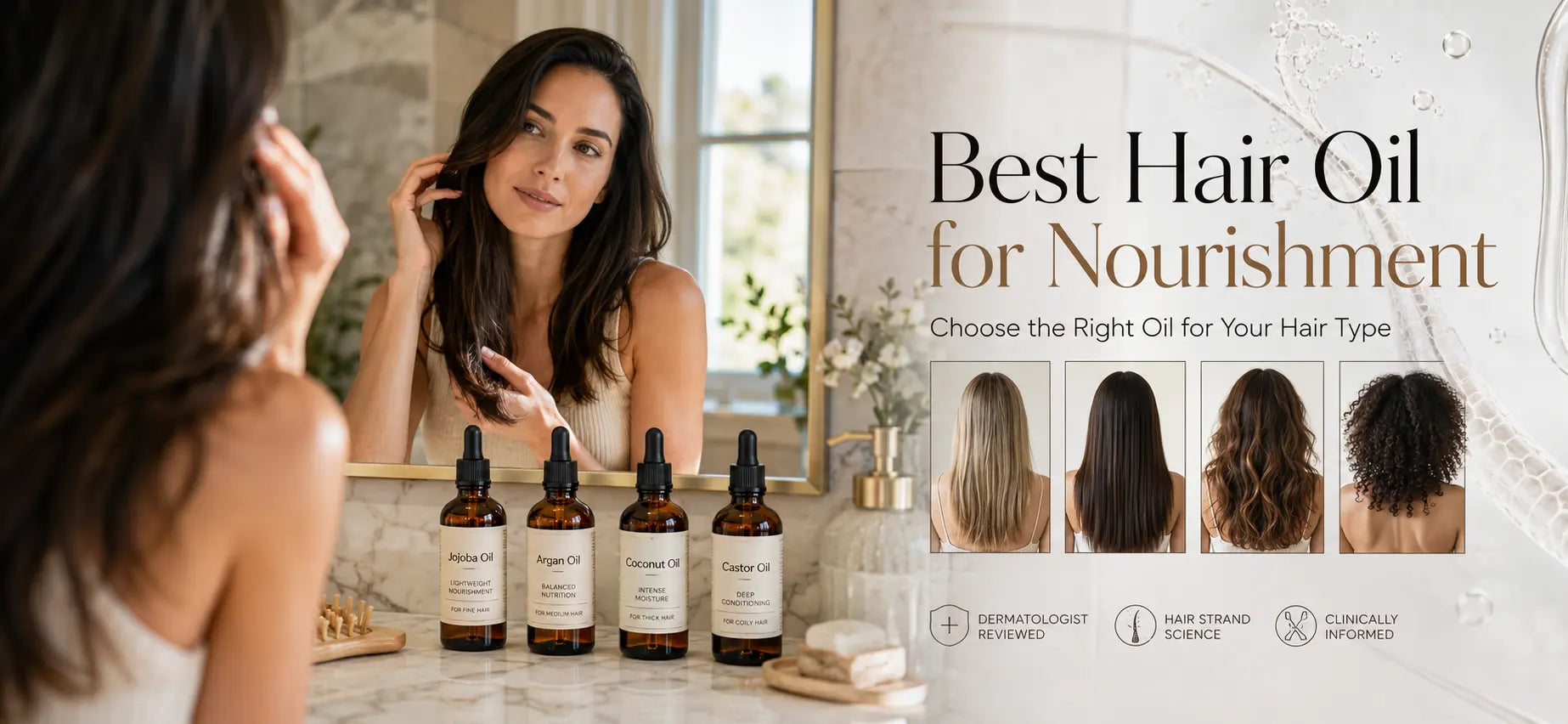
There is no single best hair oil for nourishment. The oil that genuinely nourishes one person's hair can leave another person's hair looking flat, greasy, or completely unchanged.
What determines the right choice is not the marketing claim on the bottle. It comes down to three structural facts about your own hair: how thick each individual strand is, how your natural curl or wave pattern distributes oil along the strand, and whether your hair is currently healthy or chemically processed.
Once you know where your hair sits on these three factors, choosing the right oil becomes straightforward. This guide breaks down exactly which oils work for which hair type, and why each one works.
Quick summary, matched by hair type
- Fine or thin hair needs lightweight oils that absorb fully: jojoba, argan, or grapeseed.
- Thick or coarse hair can handle heavier oils that provide more substantial conditioning: coconut, castor, or olive.
- Curly and coily hair needs a water-based moisturiser applied first, with oil used afterwards to seal that moisture in, not as a stand-alone hydrator.
- Colour-treated or chemically processed hair benefits most from oils with documented protein-protective effects, primarily coconut oil.
- An oily scalp with dry ends needs a dual approach: a lightweight, sebum-like oil at the scalp and a heavier sealing oil reserved for the ends only.
At a Glance: Best Oil by Hair Type
| Hair Type | Recommended oils | Why it works | what to avoid |
| Fine or thin | Jojoba, argan, grapeseed | Lightweight, low comedogenic, absorbs without residue | Castor or coconut applied in large amounts |
| Thick or coarse | Coconut, castor, olive | Higher diameter and more cuticle layers can carry heavier oils | Very light oils alone, which absorb too quickly to condition fully |
| curly or coily | Jojoba or coconut to seal, after a water-based leave-in | Coiled structure limits sebum distribution to the ends | Applying oil to dry hair as a substitute for water-based moisture |
| colour-treated or damaged | Coconut oil as a pre-wash treatment | Documented to reduce protein loss from the compromised shaft | Heat styling immediately after oiling without a protectant |
| Oily scalp, dry ends | Jojoba at the scalp, coconut or castor on ends only | Jojoba mimics sebum and will not add to existing oiliness | Heavy oils applied to the scalp itself |
| Dense or South Asian textures | Coconut, castor, sesame, or amla, diluted for the climate | Thicker shaft diameter historically suited to heavier traditional oils | Using the same heavy quantity year-round regardless of humidity |
Quick Self-Check Before You Choose
Before reading the detailed breakdown below, a short self-assessment narrows down which section applies to you.
- Does your hair feel weighed down or look greasy within a few hours of applying any oil? This points towards fine or thin hair.
- Does your hair seem to absorb oil quickly without ever looking shiny or coated? This points towards thick or coarse hair.
- Do your roots feel oily within a day or two of washing while your ends stay dry and rough? This points towards an oily scalp with a sebum distribution issue, which is also common with curl patterns.
- Has your hair been coloured, bleached, permed, or chemically straightened in the last six months? This points towards prioritising protein protection over general conditioning.
Fine or Thin Hair: Lightweight Oils Without Weighing It Down
Fine hair has a smaller diameter and fewer cuticle layers than thick or coarse hair. This means it has less physical capacity to carry oil before it starts to look saturated rather than nourished. The goal with fine hair is full absorption, not a visible coating.
Why jojoba oil works well here
Jojoba is technically a liquid wax ester, not a true oil. Its molecular structure closely resembles human sebum, which is why it is classified as low comedogenic and absorbs without leaving a heavy residue.
- It will not clog follicles, which matters on fine hair where scalp visibility is often higher.
- It can help regulate oil production at the scalp over time, since the scalp registers it as similar to its own sebum rather than as an external coating.
- It is rich in vitamin E, B vitamins, and antioxidants that support the scalp environment without adding bulk to the strand.
Other lightweight options
- Argan oil: rich in vitamin E and fatty acids, smooths the cuticle and adds shine without weighing down finer strands.
- Grapeseed oil: one of the lightest plant oils available, suitable for daily use on fine hair without any buildup risk.
Apply lightweight oils to the mid-lengths and ends only, using one to two drops at most. Scalp application should be minimal and infrequent, once a week is generally sufficient, since fine hair scalps are more prone to looking oily quickly.
Thick or Coarse Hair: Why Heavier Oils Work Better Here
Thick and coarse strands have a larger diameter and more cuticle layers than fine hair. This gives them a higher capacity to absorb and hold onto oil, which means lighter oils often get absorbed too quickly to provide lasting conditioning.
Coconut oil: the strongest evidence for this hair type
Coconut oil is the most clinically evidenced oil for reducing structural damage in hair. A study published in the Journal of Cosmetic Science found that coconut oil reduces protein loss from the hair shaft by up to 39 percent when used as a pre-wash treatment, outperforming both mineral oil and sunflower oil
- Lauric acid, the dominant fatty acid in coconut oil, has a small molecular size and a straight chain structure that allows it to penetrate into the hair cortex rather than just sitting on the surface.
- This penetration is what differentiates coconut oil from purely surface-coating oils, and it is particularly valuable for coarse hair, which loses moisture more readily through its larger surface area.
Castor oil for sealing and conditioning
Castor oil's high viscosity, driven by its 85 to 90 percent ricinoleic acid content, makes it a strong sealing agent rather than a penetrating one. On thick or coarse hair, this thickness is an advantage rather than a drawback, since the strand has enough surface area and cuticle layering to use a heavier product without looking weighed down.
- Diluting castor oil with a lighter carrier oil at a ratio of roughly one part castor to three or four parts coconut or jojoba makes it easier to distribute through coarse hair.
- It is best applied to mid-lengths and ends, or as a scalp treatment massaged in for several minutes before washing out thoroughly.
Skin Ritual’s Castor Oil (200ml) is cold-pressed, hexane-free, and 99.6% pure, making it suitable for the dilution approach described above without added mineral oils or synthetic fragrances diluting its effectiveness.
Olive oil as a heavier alternative
Olive oil is rich in oleic acid, a fatty acid with a larger molecular structure than the lauric acid in coconut oil. It conditions effectively on coarse hair but does not penetrate the shaft as efficiently as coconut oil, making it better suited as a pre-wash surface treatment than a deep conditioning option.
Curly and Coily Hair: Why Oil Alone Is Not Enough
Curly and coily hair have a coiled or spiral structure that makes it physically difficult for sebum produced at the scalp to travel down the length of the strand. The result is hair that is frequently dry at the ends even when the scalp itself produces a normal or higher amount of natural oil.
The structural reason curls run dry
- The twists and bends in the hair shaft mean sebum has a longer, more obstructed path to travel compared to straight hair.
- Many curl patterns also have a more open or raised cuticle structure, which allows moisture to both enter and escape more easily.
- This combination explains why curly hair can be simultaneously prone to absorbing moisture quickly and losing it just as fast.
Oil seals moisture, it does not deliver it
This is the most commonly misunderstood part of curly hair care. Oil applied to completely dry hair does not hydrate the strand. Oil forms a barrier on the surface that slows down moisture loss once moisture is already present, but it does not introduce water or water-based hydration into the strand itself.
- The correct sequence is to apply a water-based leave-in conditioner or cream first, while the hair is still damp from washing.
- Oil is then applied on top to seal that moisture in and reduce evaporation, not as the primary hydrating step.
- Applying oil to bone-dry hair first can actually make it harder for water-based products to penetrate afterwards, since the oil coating repels water.
Matching the oil to your curl pattern
Looser curls or finer curl patterns: argan or jojoba, both light enough to avoid weighing down the curl's natural bounce.
Tighter curls or coily patterns: coconut oil or a diluted castor oil blend, since denser curl patterns can typically handle and benefit from a heavier sealant.
Colour-Treated or Chemically Processed Hair: Prioritising Protein Protection
Chemical processing, including bleach, oxidative colour, and chemical straightening, disrupts the disulphide bonds within the keratin structure of the hair shaft. This leaves the hair more porous, meaning it absorbs and loses both moisture and protein more readily than untreated hair.
Why protein protection matters more than general moisture here
- Protein loss from a damaged cuticle is a primary driver of the brittleness and breakage commonly seen in chemically treated hair.
- Coconut oil is the only commonly available hair oil with strong clinical evidence specifically for reducing this protein loss, due to its ability to penetrate the cortex.
- Used consistently as a pre-wash treatment, it provides a protective effect before the hair is exposed to the swelling and stress of washing.
Practical application for processed hair
- Apply coconut oil to dry hair 30 to 60 minutes before washing, focusing on the most processed sections.
- Avoid applying any oil immediately before heat styling unless it is specifically formulated as a heat protectant, since oils can lower the scorch point of hair under direct heat.
- Reduce the frequency of further chemical processing where possible while the hair recovers, since oils support the existing structure but cannot reverse damage that has already occurred.
Oily Scalp with Dry Ends: The Dual-Zone Approach
This combination is common and often poorly addressed by generic hair oil advice, because the scalp and the ends genuinely need different things at the same time.
Why this happens
- The scalp's sebaceous glands may be producing a normal or even excessive amount of natural oil at the root.
- That oil does not travel efficiently to the ends, particularly if the hair has any wave or curl pattern, or if the ends are older and more weathered than the hair closer to the root.
- The result is a scalp that looks oily within a day or two of washing while the ends remain dry, rough, and prone to split ends.
The dual-zone solution
- At the scalp: use jojoba oil sparingly, since its sebum-like structure will not meaningfully add to existing oiliness and may help signal to the scalp that sufficient oil is already present.
- On the ends: use a heavier oil such as coconut or a diluted castor oil blend, applied only from mid-length downward, never near the roots.
- Avoid applying any oil to the scalp more than once or twice a week in this scenario, since overuse can contribute to buildup on a scalp that is already producing enough natural oil.
A note on removal: Skin Ritual's sulphate-free Anti-Hair Fall Shampoo is formulated to cleanse effectively without stripping the scalp's natural barrier, which is particularly useful for this hair type. A shampoo that is too harsh can trigger the scalp to overproduce oil to compensate, worsening the exact imbalance this approach is trying to correct.
Dense or South Asian Hair Textures: Matching Tradition with Science
Many South Asian hair textures share a thicker individual strand diameter and a higher overall hair density than the textures most commonly referenced in Western haircare content. This is precisely why traditional South Asian oiling practices have historically favoured heavier oils such as coconut, mustard, sesame, and castor, alongside amla for its vitamin C content.
Why the tradition holds up scientifically
- Thicker, denser hair has the structural capacity to use heavier oils without looking weighed down, consistent with the same principle covered earlier for coarse hair generally.
- The traditional practice of champi, a warm oil scalp massage, has independent clinical evidence behind it. A study published in ePlasty found that standardised scalp massage over 24 weeks produced a statistically significant increase in hair thickness, separate from whatever oil was used.
- This means the massage component of the practice carries real, documented benefit on its own, while the oil adds conditioning, scalp lubrication, and in the case of castor oil, anti-inflammatory support.
Adapting the tradition for the Australian climate
Many of these oiling traditions developed in climates with higher ambient humidity than much of Australia. Lower humidity and indoor heating, particularly during the Australian winter, can mean that the same heavy quantity of oil used year-round in a more humid climate becomes excessive in a drier one, leading to buildup rather than conditioning.
- Consider reducing the quantity, though not necessarily the oil type, during drier months.
- Increase the thoroughness of removal during washing if buildup is noticed, using a sulphate-free shampoo that can still cut through heavier oils effectively.
How to Apply Oil Correctly, Regardless of Type
Once you have identified the right oil category for your hair, a few application principles apply broadly across all hair types.
- Pre-wash application, left on for 30 to 60 minutes before shampooing, is the most evidence-supported method for protein-protective and conditioning oils such as coconut.
- Heavier oils such as castor benefit from dilution with a lighter carrier oil to make even distribution easier and to reduce the difficulty of washing them out.
- Once or twice weekly is generally sufficient for most hair types. Daily heavy oil use is rarely necessary and increases the risk of scalp buildup.
- Always patch test a new oil on the inner forearm and wait 24 hours before first applying it to the scalp, since contact allergies to certain plant oils, while uncommon, are documented in clinical literature.
When Hair Oil Alone Will Not Be Enough
Hair oil genuinely improves the condition, texture, and appearance of the hair shaft. It is not designed to address every hair concern, and being clear about its limits matters.
- If you are experiencing significant hair shedding, meaning full strands with a visible root bulb coming out in large numbers, the cause is likely systemic rather than something a hair oil can resolve. Stress, hormonal changes, thyroid function, and nutritional deficiencies all require their own investigation and treatment.
- If your hair is breaking rather than shedding, meaning short, ragged strands without a root bulb, oil can genuinely help, but the underlying cause of the breakage, whether heat, chemical processing, or mechanical stress, should also be addressed directly.
- If you notice patchy bald areas rather than diffuse thinning, this points towards a condition that needs a dermatologist's assessment rather than a haircare adjustment.


