

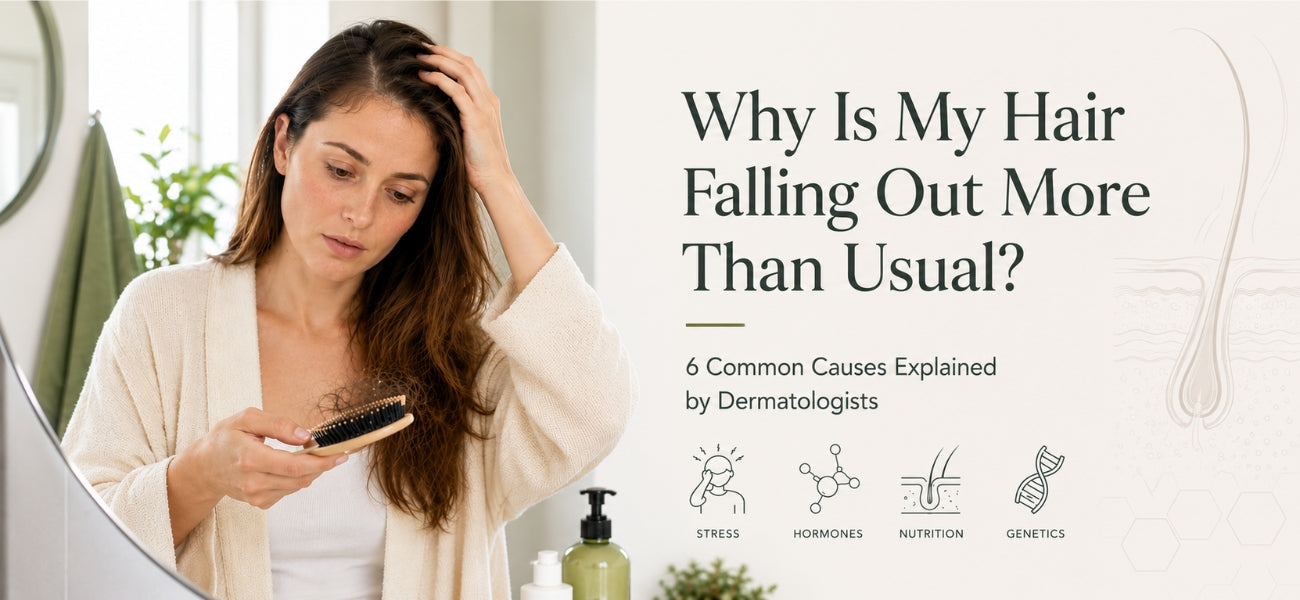
You run your fingers through your hair and a clump comes with them.
You look at your shower drain and feel a wave of panic.
Your pillow has more hair on it than it did six months ago.
If this sounds familiar, you are not imagining it. And you are definitely not alone. Millions of people notice their hair falling out more than usual at some point in their lives, and most of the time, there is a clear, treatable reason behind it.
This guide breaks down the 6 most common dermatologist-backed causes of excessive hair fall, what your body is trying to tell you, and what you can actually do about it.
How Much Hair Fall Is Actually Normal?

Before you panic, it helps to know what normal looks like.
The average person loses between 50 and 100 strands of hair every single day. This is part of the natural hair growth cycle and is completely healthy.
Hair grows in three phases: the growth phase (anagen), the transition phase (catagen), and the resting or shedding phase (telogen). When more hairs than usual enter the shedding phase at the same time, you notice an increase in hair fall.
The 100 Strands Rule Explained
If you are consistently losing more than 100 strands per day, seeing visible thinning, or noticing a widening part, that is when it becomes worth investigating.
Seasonal shedding (especially in autumn) is also normal and usually resolves within 2 to 3 months on its own.
Cause 1: Stress and Hair Loss (Telogen Effluvium)
This is the most common reason people notice their hair falling out more than usual, and it often catches people off guard.
When your body goes through a period of intense physical or emotional stress, it redirects its energy away from non-essential functions. Hair growth is one of them.
How Stress Pushes Hair Into the Shedding Phase
The condition is called Telogen Effluvium. Stress triggers a large number of hair follicles to skip the growth phase and jump straight into the resting phase. Two to three months later, all that hair sheds at once.
This is why you might experience a sudden spike in hair fall weeks or even months after a stressful event, not during it.
Common triggers include:
- A major illness or surgery
- Sudden weight loss or crash dieting
- A traumatic emotional event
- Prolonged work or life stress
- A serious fever or infection
How Long Does Stress-Related Hair Loss Last?
The good news is that telogen effluvium is almost always temporary. Once the stressor is removed or managed, hair typically starts regrowing within 3 to 6 months.
Managing stress through sleep, movement, and mindfulness is the most effective first step.
Cause 2: Nutritional Deficiencies and Hair Fall
Your hair is made of a protein called keratin. It needs a steady supply of vitamins and minerals to grow strong and stay anchored to your scalp.
When your diet lacks key nutrients, your body prioritises vital organs over hair follicles. The result is increased shedding and slower regrowth.
Iron, Zinc, Biotin and Vitamin D
These are the four nutrients most commonly linked to hair fall:
|
How It Affects Hair | Common Signs of Deficiency | |
| Iron | Carries oxygen to hair follicles | Fatigue, pale skin, brittle nails | |
| Zinc | Supports hair tissue growth and repair | Slow wound healing, white spots on nails | |
| Biotin (B7) | Strengthens keratin structure | Brittle hair and nails, skin rashes | |
| Vitamin D | Stimulates new hair follicle growth | Fatigue, bone pain, low mood |
Signs Your Diet Is Affecting Your Hair
- Hair fall increased after a period of restrictive eating or dieting
- Hair feels thinner and more brittle than before
- Nails are also weak or breaking easily
- You feel tired, cold, or foggy even with adequate sleep
A simple blood test with your GP can confirm whether a deficiency is behind your hair fall.
Cause 3: Hormonal Imbalance and Hair Loss
Hormones play a huge role in the hair growth cycle. When they shift, hair is often the first place you see it.
This is especially common in women, whose hormone levels fluctuate with menstrual cycles, pregnancy, perimenopause, and menopause.
Thyroid, PCOS, and Hair Thinning
Two of the most common hormonal causes of hair loss are:
Thyroid disorders: Both an underactive thyroid (hypothyroidism) and an overactive thyroid (hyperthyroidism) can cause diffuse hair thinning across the scalp. Hair usually grows back once thyroid levels are managed.
PCOS (Polycystic Ovary Syndrome): Elevated androgens (male hormones) in women with PCOS can shrink hair follicles and cause hair to thin at the crown or temples, similar to male pattern baldness.
Other hormonal causes include:
- Coming off the contraceptive pill
- Perimenopause and menopause (falling oestrogen levels)
- Testosterone imbalances
Hormonal Hair Loss vs Normal Shedding
| Feature | Normal Shedding | Hormonal Hair Loss |
| Pattern | Diffuse, all over | Often at crown, temples, or parting |
| Onset | Gradual | Can be gradual or sudden |
| Duration | Resolves in weeks | Continues unless treated |
| Hair regrowth | Full regrowth | May thin over time if untreated |
If you suspect hormonal hair loss, a blood test checking your thyroid function, iron levels, and androgen levels is a good starting point.
Cause 4: Postpartum Hair Loss
If you have recently had a baby and are noticing dramatic hair shedding around 3 to 4 months after giving birth, this is completely normal and has a name: postpartum hair loss (or postpartum telogen effluvium).
Why Hair Falls Out After Pregnancy
During pregnancy, elevated oestrogen levels keep hair in the growth phase longer than usual. This is why many women enjoy thicker, more lustrous hair during pregnancy.
After delivery, oestrogen levels drop rapidly. All that hair that was being held in the growth phase suddenly enters the shedding phase at the same time.
The result can feel alarming, but it is simply your body returning to its normal hair cycle.
When Does Postpartum Hair Loss Stop?
For most women, postpartum hair loss peaks at around 4 months after delivery and resolves completely by month 6 to 12.
Eating a nutrient-rich diet, continuing postnatal vitamins, and using a strengthening shampoo can help support hair through this period.
Cause 5: Scalp Health and Hair Fall
A healthy scalp is the foundation of healthy hair. If your scalp is inflamed, clogged, or struggling, your hair follicles cannot do their job properly.
Dandruff, Scalp Inflammation and Hair Fall
Conditions that directly affect hair fall include:
- Seborrhoeic dermatitis (dandruff): Chronic inflammation of the scalp that can weaken hair roots over time
- Scalp psoriasis: Thick scale buildup that blocks follicles and disrupts growth
- Folliculitis: Inflammation or infection of hair follicles that can cause patchy shedding
- Contact dermatitis: Allergic reactions to hair products that irritate the scalp
How an Unhealthy Scalp Weakens Hair Roots
Think of your scalp like soil. Healthy soil grows strong plants. Inflamed, clogged, or dry soil produces weak ones.
When the scalp is inflamed, blood flow to the follicles is reduced. This starves hair roots of oxygen and nutrients, causing strands to weaken and shed prematurely.
Regular scalp care, including gentle cleansing, exfoliation, and targeted treatments like rosemary oil, can make a significant difference.
Cause 6: Wrong Hair Care Habits
Sometimes the cause of excessive hair fall is not internal at all. It is what you are doing to your hair every day.
Heat, Chemical Damage and Tight Hairstyles
The following habits are among the most common physical causes of hair breakage and loss:
- Excessive heat styling: Daily use of straighteners, curling wands, or blow dryers above 180°C weakens the hair shaft and causes breakage
- Chemical treatments: Bleaching, perming, and relaxing damage the hair structure and weaken roots over time
- Tight hairstyles: Constant tension from tight ponytails, braids, or buns can cause a condition called traction alopecia, where hair follicles are permanently damaged
- Aggressive brushing: Brushing wet hair or using the wrong brush causes breakage, especially on fragile or fine hair
Ingredients in Shampoo That Cause Hair Fall
Many everyday shampoos contain ingredients that strip the scalp and weaken hair over time:
- Sulphates (SLS/SLES): Harsh detergents that strip natural oils and irritate the scalp
- Silicones: Build up on the scalp and clog follicles over time
- Parabens: Preservatives that can disrupt hormones and scalp health
- Synthetic fragrances: Common irritants that cause contact dermatitis in sensitive scalps
Switching to a sulphate-free, scalp-friendly shampoo is one of the simplest changes you can make.
How to Stop Hair Falling Out More Than Usual
Now that you know the causes, here is a practical action plan.
1. Address Your Diet First
- Add iron-rich foods: spinach, lentils, red meat, pumpkin seeds
- Eat protein at every meal (hair is made of protein)
- Consider a hair-specific supplement with biotin, zinc, and Vitamin D
- Get a blood test to rule out deficiencies before supplementing
2. Build a Scalp Care Routine
- Wash hair regularly with a gentle, sulphate-free shampoo
- Use a scalp-specific treatment or oil 1 to 2 times per week
- Massage your scalp for 3 to 5 minutes when applying oil or shampoo to boost circulation
- Avoid scratching or picking at the scalp
3. Manage Stress Actively
- Prioritise 7 to 9 hours of sleep
- Include 20 to 30 minutes of movement daily
- Reduce caffeine and alcohol which both contribute to cortisol spikes
- Try breathwork or mindfulness if stress is chronic
4. Choose the Right Hair Products
- Sulphate-free shampoo for regular cleansing
- Conditioner every wash to maintain moisture and reduce breakage
- Heat protectant before any hot tool use
- Anti-hair fall or rosemary-based products for active hair loss phases
Conclusion
Hair falling out more than usual is rarely a sign of something you cannot fix.
In most cases, your body is sending a clear signal: it needs better nutrition, less stress, a healthier scalp, or gentler care.
The first step is identifying your cause. The second is acting on it consistently.
Whether it is switching your shampoo, adding iron to your diet, managing stress, or supporting your scalp, small changes done consistently lead to real results.
Your hair can and does grow back. It just needs the right conditions.
Not sure where to start with your overall routine? Our scalp and skin care routine guide covers everything from cleansing to treatment, step by step.


