

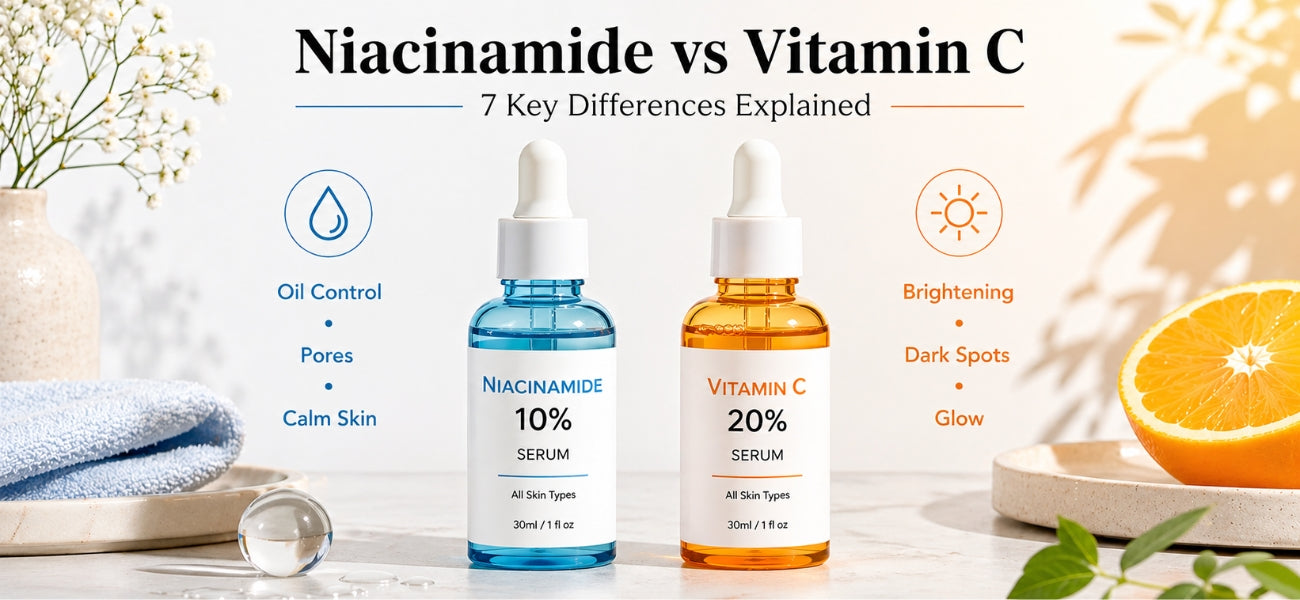
You are standing in a skincare aisle, or scrolling through a website, and you see two serums staring back at you.
Niacinamide and Vitamin C.
Both are highly rated. Both promise glowing, clearer skin. Both are in almost every skincare expert's top list.
So which one do you actually need?
The answer depends on your skin type, your skin concerns, and how you plan to build your routine. In this guide, we break down 7 key differences between niacinamide and vitamin C serum so you can make the right choice for your skin.
What Is Niacinamide?
Niacinamide is a form of Vitamin B3. It is a water-soluble vitamin that works on the surface of the skin and inside the skin barrier at the same time.
It is one of the most versatile skincare ingredients available. It suits almost every skin type, is gentle enough for sensitive skin, and addresses a wide range of concerns from oiliness to pigmentation to ageing. If you want a deeper look, we have covered all the Niacinamide skin benefits that actually work.
Common concentrations: 5% for sensitive or beginner skin, 10% for oily, acne-prone, or more experienced users.
What Is Vitamin C Serum?
Vitamin C (also called L-Ascorbic Acid in its purest form) is a powerful antioxidant. It protects the skin from free radical damage caused by UV rays and pollution, and it actively brightens the skin by reducing melanin production.
It is the gold standard ingredient for anyone dealing with dull skin, uneven tone, dark spots, or early signs of ageing.
Common concentrations: 10% for beginners, 20% for more experienced users wanting stronger brightening effects.

7 Key Differences Between Niacinamide and Vitamin C Serum
Difference 1: What They Actually Do for Your Skin
Both serums improve your skin, but they target completely different problems.
Niacinamide works best for:
- Controlling excess oil and shine
- Minimising the appearance of enlarged pores
- Reducing redness, blotchiness, and acne marks
- Strengthening the skin barrier
- Gently fading mild hyperpigmentation over time
Vitamin C works best for:
- Brightening dull, tired-looking skin
- Fading dark spots, sun damage, and post-acne marks
- Boosting collagen production for firmer skin
- Protecting skin from daily UV and pollution damage
- Evening out skin tone
Bottom line: If your main concern is oiliness or breakouts, start with niacinamide. If your main concern is dullness or dark spots, start with Vitamin C.
Difference 2: Which Skin Types Benefit Most
This is often the deciding factor for most people when choosing between the two serums.

Difference 3: Stability and Ease of Use
This is a practical difference that affects how easy each serum is to use day to day.
Niacinamide:
- Very stable ingredient, does not degrade easily
- Works in most formulas and pH levels
- Can be used morning or night without issue
- Does not require special storage conditions
Vitamin C:
- L-Ascorbic Acid (pure Vitamin C) is notoriously unstable
- Degrades quickly when exposed to air, light, and heat
- Turns orange or brown when oxidised, which means it has lost potency
- Needs to be stored in a dark, cool place and used within 3 months of opening
- More stable derivatives (like Vitamin C phosphate) are gentler but slightly less potent
Storage tip: Keep your Vitamin C serum in a dark cupboard or refrigerator. If it has turned dark orange or brown, it is time to replace it.
Difference 4: How Quickly You See Results
Patience is part of every skincare routine, but these two serums work on different timelines.

Niacinamide tends to show faster results for oiliness and redness. Vitamin C takes longer for deep pigmentation but delivers a visible glow relatively quickly.
Difference 5: Skin Sensitivity and Irritation Risk
Not all active ingredients are created equal when it comes to how your skin tolerates them.
Niacinamide:
- Extremely well-tolerated across all skin types
- Rarely causes irritation even at 10%
- Safe for rosacea, eczema-prone, and reactive skin
- No purging phase
Vitamin C:
- High-percentage L-Ascorbic Acid (15 to 20%) can sting or tingle on sensitive skin
- Low pH formulas can cause temporary redness on thin or reactive skin
- Beginners should start at 10% before moving to 20%
- More stable derivatives are gentler but can be less effective
Sensitive skin tip: If your skin is reactive, start with niacinamide first. Once your barrier is stronger, you can introduce Vitamin C gradually.
Difference 6: How They Fit Into Your Routine
Knowing when and how to use each serum is just as important as choosing the right one.
Niacinamide:
- Use morning or night, it is flexible
- Apply after cleansing and toning, before moisturiser
- Pairs well with most other ingredients including AHA, BHA, and Hyaluronic Acid
- No SPF requirement but always recommended in the morning
Vitamin C:
- Best used in the morning because it boosts SPF effectiveness and fights UV-caused free radicals during the day
- Apply after cleansing, before moisturiser and SPF
- Always follow with SPF 30+ in the morning for maximum benefit
- Avoid using directly with retinol or AHAs in the same step as it can cause irritation
Ideal morning order: Cleanser, Niacinamide or Vitamin C Serum, Moisturiser, SPF. Ideal night order: Cleanser, Niacinamide Serum, Moisturiser.

Want to build a complete routine around these serums? Check out our Best Skincare Routine for Your Skin Type guide.
Difference 7: Price and Value for Money
Both ingredients are widely available and affordable, especially compared to peptide or retinol serums.

Budget tip: If you are just starting out and can only buy one serum, niacinamide gives you more value because it is stable, multi-tasking, and lasts longer.
Can You Use Niacinamide and Vitamin C Together?
This is one of the most searched questions about these two ingredients, and the answer is yes, but with the right approach.
There used to be a belief that niacinamide and Vitamin C cancel each other out or cause flushing. This has since been debunked by research. The reaction only happens at very high temperatures, not on your skin.
However, using both in the same step at the same time can reduce the effectiveness of Vitamin C slightly because they work at different optimal pH levels.
The smarter approach:
- Use Vitamin C in the morning (antioxidant protection + SPF synergy)
- Use Niacinamide at night (barrier repair + oil control while you sleep)
- Or apply them separately in the same routine with a few minutes gap between
Pro tip: Many people find the morning Vitamin C and night Niacinamide split to be the most effective routine. Your skin gets the best of both ingredients without any conflict.
Niacinamide vs Vitamin C: Full Comparison at a Glance

Which Serum Should You Choose?
Here is a simple way to decide:
Choose Niacinamide if you:
- Have oily or combination skin
- Struggle with acne, breakouts, or enlarged pores
- Have sensitive or reactive skin
- Are new to active ingredients and want a gentle start
- Want a stable, easy-to-use everyday serum
Choose Vitamin C if you:
- Have dull or uneven skin tone
- Have dark spots, sun damage, or post-acne marks
- Are focused on anti-ageing and collagen support
- Already have a solid basic routine and want to add a brightening step
- Want to boost the effectiveness of your daily SPF
Use both if you:
- Want comprehensive results: oil control AND brightening
- Have combination skin with both oiliness and dark spots
- Are comfortable with a multi-step routine
Skin Ritual offers both a 10% Niacinamide Serum and a 20% Vitamin C Serum, formulated with clinically-backed concentrations at an affordable price. Whether you need one or both, find your perfect match at skinritual.com.au
Conclusion
Niacinamide and Vitamin C are two of the most powerful and proven skincare ingredients available. They are not competitors. They are a team.
Niacinamide keeps your skin clear, balanced, and calm. Vitamin C keeps your skin bright, protected, and youthful.
If you can only choose one right now, let your skin concern guide you. Oily and acne-prone skin, go with niacinamide. Dull, uneven, or ageing skin, go with Vitamin C.
And when you are ready for both, use them at different times of day and let your skin enjoy everything they offer.
Ready to start? Shop Skin Ritual's 10% Niacinamide Serum and 20% Vitamin C Serum at skinritual.com.au. Affordable, active-ingredient skincare made for every skin type.


