

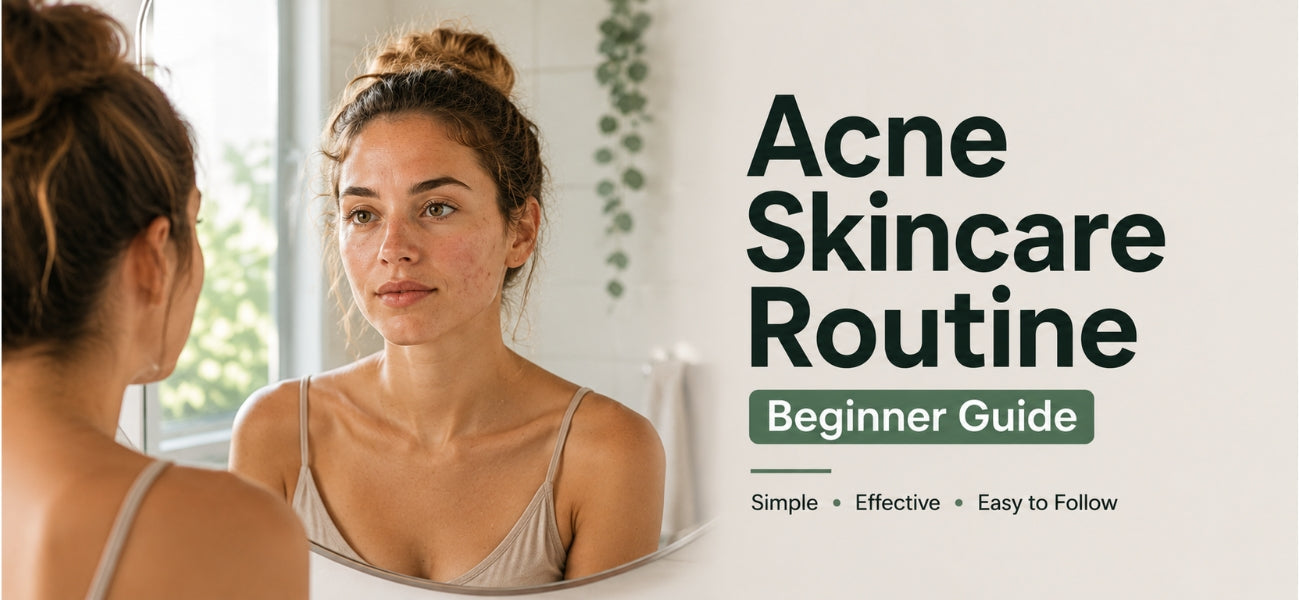
You wake up, look in the mirror, and there it is. Another breakout.
You've tried everything. Different face washes, random spot creams, things your friend swore by. But your skin just keeps acting up.
Here's the truth: most people with acne-prone skin aren't using the wrong products. They're using too many, in the wrong order, with the wrong ingredients.
If you're a beginner based in Australia, this guide is written specifically for you. We'll walk you through a simple, affordable skincare routine for acne-prone skin using active ingredients that are scientifically proven to work. Step by step. No confusion.
No overwhelming 10-step routines. No expensive splurges. Just a clear, beginner-friendly plan.
Let's fix your skin.
Why Do You Get Acne? (The Real Reason)
Before we get into routines, let's quickly understand what's happening on your skin.
Acne forms when:
- Dead skin cells clog your pores
- Excess oil (sebum) gets trapped inside
- Bacteria multiply and cause inflammation
- Hormones trigger oil overproduction
Most people make one big mistake: they try to "dry out" acne. They strip their skin with harsh products, which actually makes oil production worse.
The smarter approach? Balance your skin. Control oil, exfoliate gently, and keep your skin barrier healthy. That is exactly what a good skincare routine for acne-prone skin is built around.

What to Look for in Acne Skincare Products (Ingredients That Work)
Not all ingredients are created equal. Here are the ones that are actually backed by science for acne-prone skin:
| Ingredient | What It Does | Best For |
|---|---|---|
| Niacinamide (10%) | Controls oil, reduces redness, fades dark spots | All acne types |
| Salicylic Acid (BHA) | Unclogs pores, reduces blackheads | Oily, congested skin |
| AHA (Glycolic/Lactic) | Exfoliates dead skin cells, improves texture | Post-acne marks |
| Ceramides | Repairs skin barrier, locks in moisture | Dry or irritated acne skin |
| Kojic Acid | Fades post-acne pigmentation | Dark spots & uneven tone |
Beginner tip: You don't need all of these at once. Start with Niacinamide. It's the safest, most well-tolerated active ingredient for beginners who are just starting their skincare routine for acne-prone skin.
The Complete Beginner Skincare Routine for Acne-Prone Skin
Here's your simple, effective 4-step routine split into morning and night. Follow this consistently and your skin will thank you for it.
Step 1: Cleanser — Remove Oil, Dirt and Impurities
Morning & Night
The foundation of any acne routine is a good cleanser. For acne-prone skin, you want something that:
- Removes excess oil without over-stripping
- Contains gentle exfoliating acids (AHA or BHA)
- Doesn't leave your skin feeling tight or dry
What to use: A 3% AHA/BHA Foaming Cleanser is perfect for beginners. The AHA component gently exfoliates dead skin cells, while the BHA (salicylic acid) dives into pores to clear congestion.
How to use it:
- Wet your face with lukewarm water
- Apply a small amount of cleanser and gently massage for 30–60 seconds
- Rinse thoroughly and pat dry. Never rub.
Common mistake: Using hot water. It strips your skin barrier and triggers more oil production. Always use lukewarm water.
Step 2: Treatment Serum — Target Acne at the Source
Morning & Night
After cleansing, your skin is clean and ready to absorb active ingredients. This is where your serum works its magic.
For beginners with acne-prone skin, 10% Niacinamide Serum is the number one recommended starting point. Here is why it belongs in every skincare routine for acne-prone skin:
Niacinamide benefits for acne-prone skin:
- ✅ Reduces sebum (oil) production
- ✅ Minimises pore size
- ✅ Fades post-acne dark marks
- ✅ Reduces inflammation and redness
- ✅ Strengthens your skin barrier
- ✅ Suitable for all skin types, including sensitive skin
It's essentially a multi-tasking powerhouse. Instead of buying 5 different products, one good Niacinamide serum handles most acne-related concerns.
How to apply:
- Apply 2–3 drops onto clean, dry skin
- Gently press (don't rub) into face and neck
- Wait 60 seconds before moving to the next step
Step 3: Moisturiser — Never Skip This (Yes, Even for Oily Skin)
Morning & Night
This is the biggest myth in acne skincare: "My skin is oily, I don't need a moisturiser."
Wrong. Here's why:
When your skin is dehydrated, it produces more oil to compensate. This creates a vicious cycle. More oil leads to more clogged pores, which leads to more acne.
The solution is a lightweight, oil-free moisturiser with Ceramides and Hyaluronic Acid (HA).
Ceramides repair your skin barrier, which is the protective layer that keeps moisture in and irritants out. When your barrier is strong, your skin calms down, produces less oil, and heals faster.
What to use: A Ceramide + HA Oil-Free Moisturiser is ideal for acne-prone skin. It hydrates without clogging pores (non-comedogenic) and actively supports barrier repair.
How to apply:
- Take a small pea-sized amount
- Warm between your fingers
- Press gently onto face and neck
Pro tip: If your skin feels oily after a few hours, it is not the moisturiser's fault. It simply means your barrier needs more time to repair. Stick with it for 3 to 4 weeks before judging.
Step 4 (Morning Only): Sunscreen — The Most Underrated Acne Step
Morning only. Non-negotiable.
If you're using AHA, BHA, Niacinamide, or any active ingredient, your skin becomes more sensitive to UV rays. Sun exposure without SPF will:
- Darken post-acne marks permanently
- Slow down healing
- Cause more pigmentation
Use an SPF 30+ broad-spectrum sunscreen every single morning, even on cloudy days and even indoors near windows.
Your Weekly Routine: Add This for Faster Results
Once you've used the basic 4-step routine for 2 weeks and your skin has adjusted, you can add one extra step:
2–3x per week (Night Only): Chemical Exfoliant / Skin Peel
A 15% AHA/BHA Beginner Peel used 2–3 times a week will:
- Deeply exfoliate dead skin cells
- Unclog stubborn pores
- Dramatically speed up fading of dark spots
- Improve overall skin texture
How to use safely:
- Apply after cleansing, on dry skin
- Leave on for 5–10 minutes (start with 5)
- Rinse thoroughly
- Follow with Niacinamide serum and moisturiser
- Always use SPF the next morning
Important: Don't use the peel on the same night as other active serums. Keep it simple. On peel nights, follow: cleanser, then peel, then moisturiser only.
What About Stubborn Dark Spots From Old Acne?
Post-acne hyperpigmentation (those brown or dark marks left after a pimple heals) is one of the most common concerns for people following a skincare routine for acne-prone skin in Australia, especially for those with medium to deeper skin tones.
Here's how to tackle them:
Double up on brightening ingredients:
- Niacinamide fades dark spots by blocking melanin transfer
- Kojic Acid Soap used as your cleanser 2 to 3 times a week actively brightens existing pigmentation and prevents new dark spots from forming
1% Kojic Acid + L-Glutathione Soap is particularly effective for post-acne marks. Use it in place of your regular cleanser 2–3 times a week, let it sit for 60 seconds, then rinse.
Beginner Skincare Routine Summary (At a Glance)
🌅 Morning Routine
- Cleanse: 3% AHA/BHA Foaming Cleanser
- Treat: 10% Niacinamide + Zinc Serum
- Moisturise: Ceramide + HA Oil-Free Moisturiser
- Protect: SPF 30+ Sunscreen
Night Routine
- Cleanse: 3% AHA/BHA Foaming Cleanser
- Treat: 10% Niacinamide + Zinc Serum
- Moisturise: Ceramide + HA Oil-Free Moisturiser
2–3x Per Week (Night)
- Replace step 2 with: 15% AHA/BHA Beginner Peel
- Optional: Swap cleanser for Kojic Acid + L-Glutathione Soap to target dark spots
How Long Before You See Results?
Patience is part of the process. Here's a realistic timeline:
| Timeframe | What to Expect |
|---|---|
| Week 1–2 | Skin may purge slightly (normal) or just feel cleaner |
| Week 3–4 | Active breakouts reduce, skin feels more balanced |
| Week 6–8 | Visible improvement in dark spots, texture, and pore size |
| Week 10–12 | Significant overall improvement in skin clarity and tone |
Skin purging vs breakout: If you start a new active ingredient and get a few extra pimples in the first 2 weeks, that is purging and it is normal. If it continues beyond week 3 to 4, reassess the product.
Top 5 Mistakes Beginners Make With Acne Skincare
- Over-washing: More than twice a day strips your barrier and increases oil production
- Skipping moisturiser: Leads to dehydration and even more oil production
- Using too many actives at once: Causes irritation and skin sensitivity
- Popping pimples: Spreads bacteria and causes permanent scarring
- No sunscreen: Turns temporary dark marks into permanent pigmentation
Conclusion
Getting clear skin isn't about using every product on the shelf. It's about using the right products, in the right order, consistently.
Building a proper skincare routine for acne-prone skin does not have to be complicated or expensive. Start simple:
- A gentle AHA/BHA cleanser
- A 10% Niacinamide serum
- A ceramide moisturiser
- SPF every morning
Give it 4 to 6 weeks. Be patient with your skin. And remember, consistency beats intensity every single time.
Ready to start your acne-free journey? Explore Skin Ritual's Bundle. Everything you need is in one affordable kit, formulated by Australian healthcare professionals and designed specifically for acne-prone beginners.


